

More website owners are looking for an alternative to Google Analytics. Privacy requirements have increased demand for simpler, less intrusive analytics, while many teams also find Google’s platform unnecessarily complex for everyday reporting.
The good news is that several analytics products offer a more focused feature set, easier implementation and a privacy-oriented approach.
This overview compares some of the strongest alternatives and the situations in which each one makes sense.
What is Google Analytics?
Google Analytics remains the market leader for web analytics. It can measure websites, blogs, campaigns and complex user journeys in exceptional detail. That breadth is also its weakness: many organisations need only a fraction of its capabilities and face a steeper setup and learning curve.
The alternatives to Google Analytics in our overview:
Trackboxx

Price: from €5 per month
Trackboxx is a German-built, privacy-focused alternative to Google Analytics that measures website activity without relying on conventional tracking cookies.
It records and analyses visitor activity without creating individual user profiles. The approach is designed to minimise the personal data involved in everyday website analytics. Trackboxx Depending on your implementation and the applicable requirements, this can simplify consent management and reduce the data lost when visitors reject optional tracking.
Trackboxx deliberately offers a more focused feature set than Google Analytics while covering the metrics most website teams use regularly:
- Number of visitors
- Page impressions
- Engagement time
- Bounce rate
- Live visitors
Reports can be broken down by page and traffic source. Device, browser and geographic summaries provide additional context without turning the dashboard into an enterprise reporting suite.
Its lightweight implementation and content-delivery network also help keep the impact on page performance low.
Matomo (formerly Piwik)

from 29€ per month (self-hosted free of charge)
Matomo, formerly Piwik, is a flexible Google Analytics alternative that can be configured for cookie-free measurement. Its self-hosted option gives organisations substantial control over their analytics data.
A useful migration feature lets you import historical Google Analytics data, so earlier reports do not have to disappear when you switch platforms.
Matomo also includes conversion-optimisation tools such as heatmaps, session recordings and behavioural reports—features that often require separate specialist products.
A/B testing and session recordings make Matomo particularly useful for teams that want to improve journeys and conversion rates within the same analytics environment.
It also provides selected search and SEO reports, including keyword and ranking information where the relevant data is available.
Gauges
Price: from 6$ per month
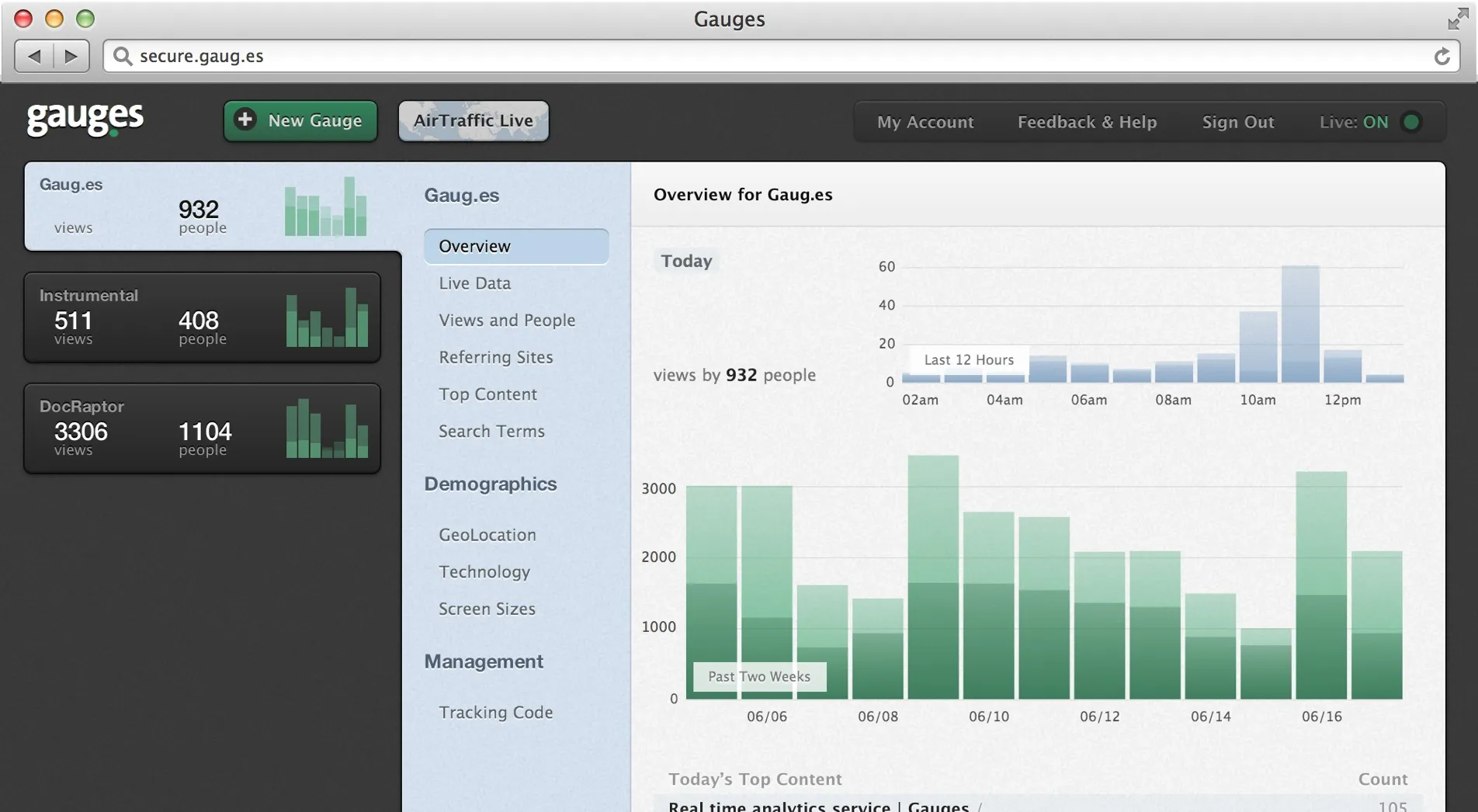
Gauges (Gaug.es) concentrates on essential metrics such as page views and visitors. Its interface is simple and quick to understand, but it does not offer the depth of a platform such as Matomo.
Its main attraction is price: entry plans include a relatively generous page-view allowance compared with many competitors.
Gauges has also explored marketing-automation features for comparing campaign profitability, customer segments and journeys.
Fathom Analytics

Price: from €14 per month
Fathom follows the same privacy-focused, cookie-light approach as tools such as Trackboxx and Simple Analytics. It presents the core metrics in a clean, compact dashboard.
Because it collects a deliberately limited dataset rather than building detailed individual profiles, the platform can process substantial traffic without an overly complex reporting model.
Fathom is well suited to essential website reporting, but offers fewer advanced journey and funnel features. Its pricing should be compared carefully with products that provide a similar core feature set.
Fathom Analytics is open source, with its code and community activity visible on GitHub.
Simple Analytics

Price: from 19$ per month
Simple Analytics is an EU-based, privacy-focused analytics platform. It avoids conventional tracking cookies and is designed to collect no personal data, reducing the consent burden in many standard configurations.
One distinctive feature is its tweet viewer, which resolves t.co referrals to the original post. That can be useful when X/Twitter is an important source of website traffic.
Plausible Analytics

Price: from €9 per month
Plausible is another lightweight, privacy-focused alternative to Google Analytics that can operate without conventional tracking cookies.
Its script is under 1 KB, helping to minimise the effect analytics has on page speed.
Plausible is open source, and technically experienced teams can self-host the software.
Prices start at €9 per month.
Mixpanel

Price: from 10$ per month
Mixpanel is better understood as a product-analytics platform than a direct replacement for Google Analytics. It helps product teams examine how people use applications and digital services.
User segmentation is central to Mixpanel. Teams can define behavioural and account attributes, build segments and compare how different groups move through the product.
Funnels, retention analysis and behavioural reports are easier to build than in many traditional web-analytics tools. Mixpanel is designed for product decisions, not only traffic reporting.
Chartbeat

Price: from 10$ per month
Chartbeat specialises in content analytics for publishers, blogs and newsrooms. It helps editorial teams understand how articles perform across audiences and channels.
Real-time reporting, app data, historical analysis and video metrics can be combined across several properties. Link-level engagement data also supports headline and presentation tests.
Automated and custom reporting is a major strength for larger editorial teams that need regular performance updates for different stakeholders.
Kissmetrics

Price: from 299$ per month
Kissmetrics supports two broad use cases—SaaS and e-commerce—with many of the same behavioural features applied to different business goals.
Unlike aggregate web analytics, Kissmetrics connects activity to identifiable customer records. That allows teams to follow a customer journey across sessions and, where correctly configured, across devices.
It can reveal where potential customers leave a journey, helping teams improve individual steps in activation or conversion. Common SaaS metrics include:
- New accounts
- New subscriptions
- Cancellations
- Conversion from demo version to paid subscription
- Monthly recurring income
- Time to register an account
- Time until implementation of new features
Kissmetrics therefore goes well beyond basic traffic analytics and is aimed at teams that need customer-level behavioural analysis.
StatCounter

Price: from 9$ per month (500 page views free of charge)
StatCounter begins with familiar metrics such as sessions, visitors and page views, making website trends easy to monitor.
Its paid-traffic analysis is designed to identify suspicious or low-quality clicks and show where advertising budget may be wasted.
Where individual visitor tracking is enabled and lawful, StatCounter can alert teams when a returning visitor reaches the website.
It also covers familiar engagement, event, click and navigation-path reports.
A mobile app makes it convenient to review headline metrics away from the desktop dashboard.
Woopra

from 999$ per month (free option possible)
Woopra focuses on customer-journey analytics and lets teams model interactions across a website or product.
Teams define and combine meaningful actions to visualise behaviour through journeys and funnels. The aim is to turn a large event stream into specific opportunities for optimisation.
Woopra supports trend analysis, cohorts, segmentation and flexible reporting, including detailed behavioural rules.
Adobe Analytics

Price: not really clear, on request
Adobe Analytics is designed primarily for large organisations that need long retention periods, advanced governance and highly customised reporting.
A limitation is that some reports are not available in real time and may appear with a delay. The reporting experience can also require significant configuration.
At enterprise scale, however, teams can build role-specific dashboards and work with detailed unsampled data. That flexibility is valuable when several departments share one analytics environment.
Adobe continues to integrate AI into analytics through Adobe Sensei, including automated pattern detection and behavioural segmentation.
All tools in the quick overview
| Tool | Data protection compliant (DSGVO) | Cookie-free | Price | Simple implementation | Open Source | Cloud/self-hosted | Special functions |
|---|---|---|---|---|---|---|---|
| Trackboxx | Yes | Yes | From €5/month | Yes | No | Cloud | GDPR-compliant, live visitors, dwell time |
| Matomo | Yes | Yes | From 29€/month | Yes | Yes | Self-Hosted | Heatmaps, A/B tests, SEO reporting |
| Gauges | Only with adjustments | No | From 6$/month | Yes | No | Cloud | Marketing automation |
| Fathom Analytics | Yes | Yes | From 14€/month | Yes | Yes | Cloud | Simple dashboard, fast tracking |
| Simple Analytics | Yes | Yes | From 19$/month | Yes | No | Cloud | Tweet viewer for Twitter traffic |
| Plausible Analytics | Yes | Yes | From €9/month | Yes | Yes | Cloud/Self-Hosted | Lightweight script, open source |
| Mixpanel | Only with adjustments | No | From 10$/month | No | No | Cloud | Funnel analysis, user segmentation |
| Chartbeat | Only with adjustments | No | From 10$/month | Yes | No | Cloud | Real-time analysis, content optimisation |
| Kissmetrics | Only with adjustments | No | From 299$/month | No | No | Cloud | Customer journey, multi-device tracking |
| StatCounter | Only with adjustments | No | From 9$/month | Yes | No | Cloud | Paid Traffic Analysis |
| Woopra | Only with adjustments | No | From 999$/month | Yes | No | Cloud | Customer journey, cohort analysis |
| Adobe Analytics | Only with adjustments | No | On request | No | No | Cloud | Customised dashboards, AI-supported analyses |
Cookie-based solutions vs. GDPR-compliant solutions
The right Google Analytics alternative depends on what you actually need to measure and who will use the data.
If aggregate metrics such as visitors, page views, engagement and bounce rate are enough, a focused privacy-oriented product may be the better fit. Simpler consent and implementation can also improve data coverage, depending on the configuration.
Customer-level journey analysis requires a different class of product and a carefully designed privacy setup. Platforms such as Mixpanel, Kissmetrics and Adobe Analytics provide deeper capabilities, but also add cost and complexity.
FAQ - Google Analytics alternatives
Why should I look for an alternative to Google Analytics?
Google Analytics is powerful, but its complexity and data-protection implications are not a good fit for every organisation. Alternatives may offer a simpler, more privacy-focused setup for common reporting needs.
What advantages do Google Analytics alternatives offer?
Alternatives to Google Analytics often offer advantages such as
- Privacy complianceSome platforms are designed to avoid personal data and conventional tracking cookies, which can simplify consent requirements depending on the implementation.
- Simple implementationOften easier to set up and use without extensive technical knowledge.
- Focus on key metricsThey often focus on essential insights such as visitor numbers, engagement and popular pages instead of reproducing every advanced Google Analytics feature.
What are the best alternatives to Google Analytics?
The best privacy-friendly alternatives include
- TrackboxxNo use of cookies, simple operation and no need for cookie banners.
- MatomoMatomo is open source and can be hosted on your own infrastructure, giving you greater control over configuration and data.
- Plausible analyticsSimple Analytics is a lightweight, privacy-focused platform that avoids conventional tracking cookies.
Are alternatives to Google Analytics just as powerful?
Yes. Many alternatives cover the core metrics needed to assess website performance. Google Analytics offers greater depth, while focused products can be easier to understand and operate.
Can I use a Google Analytics alternative without user consent?
Some cookie-free alternatives can reduce or remove the need for optional analytics consent in specific configurations. The answer still depends on the data collected, local requirements and the rest of your website setup.
These questions summarise the main differences and help you choose an analytics platform based on your actual requirements.
Is Google Analytics still permitted?
Google Analytics can be used in Europe, but the implementation must meet applicable privacy requirements. Consent, configuration, contracts, data transfers and the information in your privacy notice all need to be assessed for the specific setup.
When will Google Analytics be discontinued?
Google Universal Analytics will be launched on 1 July 2024 discontinued. From this date, data will no longer be collected in Universal Analytics. Users must click on Google Analytics 4 (GA4) which offers modern data analysis and improved data protection functions.


 Deutsch
  English (UK)
  Français
  Italiano
  Español
  Nederlands
  Polski
  Svenska